News: February 2026
Poor Posture Didn't Injure Your Spine: The Truth About Your Spinal Injury
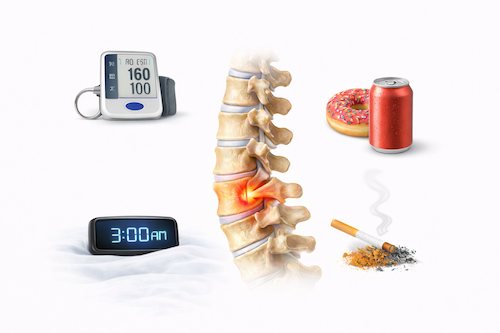 So often we're told our back pain is because of poor posture or improper lifting or a weak core. It makes sense. If your back hurts, it must be because one of your parts has gone rogue.
A new way of looking at disc degeneration
A recent large genetic study by Guo and colleagues looked at intervertebral disc degeneration - the age-related flattening, drying, and fraying of the spinal discs that so often gets blamed for back pain.
Instead of focusing on biomechanics (posture, lifting, "bad movement"), researchers went hunting in an entirely different direction: genetics, metabolism, and overall health.
They analyzed huge genetic databases using genome-wide association studies (GWAS), essentially casting a wide net across the genome to see what patterns emerged.
That kind of fishing can uncover powerful patterns, but it can also scoop up some statistical red herrings. So the researchers went a step further, using an advanced method called Mendelian randomization, which helps tease apart correlation from likely causation.
In other words, they weren't just asking whether specific health factors were associated with disc degeneration - they were asking which direction the arrow points.
The surprising villains (and non-villains)
The biggest risk factors for disc degeneration were not poor posture, spinal alignment, or mechanical "wear and tear."
Instead, the strongest causal links were:
- Poor sleep / insomnia -> about 80% higher risk
- High blood pressure (hypertension) -> about 100% higher risk
- Smoking and alcohol use -> about 20% higher risk
- Metabolic issues (high blood sugar, unhealthy fats in the blood) -> 8-30% higher risk
Sleep deprivation and metabolic health had far more impact on disc degeneration than the usual mechanical suspects.
Meanwhile, things we often assume are direct causes, like body weight or cholesterol, showed bidirectional relationships. Back pain can contribute to weight gain just as much as weight can contribute to back pain.
What about those scary MRI findings?
We are shown images of bulging or "slipped" discs, usually without any context, and almost never alongside images of healthy, pain-free people who also have degenerative disc changes - which is extremely common.
This means that disc degeneration is often a bystander, not the main event.
People with excellent fitness and overall health still develop disc changes. But those changes tend to be:
- Less severe
- Less painful
- Less likely to turn into chronic, life-disrupting pain
This explains why so many people with "messy" scans feel fine, while others with clean scans are in pain.
Fitness matters, but not in the way you've been told
Exercise is very important, but not because your spine needs perfect mechanics or because your core isn't strong enough. Movement helps your spine because discs, like all living tissue in the body, depend on:
- Blood flow
- Oxygen
- Metabolic health
- Nervous system regulation
- Sleep and recovery
Or as the authors themselves put it:
"Metabolic disturbances appear to have a more significant effect on disc degeneration than biomechanical alterations."
That single sentence dismantles decades of fear-based messaging about movement.
The popular science site Physio Meets Science summed it up perfectly:
"These findings contradict the widespread biomechanical paradigm that sees excessive physical strain as the primary causal factor for disc degeneration."
The bigger, kinder picture of back pain
Your spine is not fragile, your discs are not ticking time bombs, and pain is not a simple report card on structural damage.
If you're dealing with back pain, the most powerful levers are often the least dramatic ones.
And yes - massage therapy supports several of these:
- Better sleep
- Movement and exercise
- Cardiovascular health
- Stress reduction
- Healthy diet
- Reducing or eliminating smoking and alcohol
None of those come with shocking MRI images, but they may matter far more than posture or core strength. And since there's so much we can do to improve overall health, I find that deeply reassuring.
Source: Paul Ingraham, PainScience.com
Calm Racing Thoughts Naturally
Self-Massage for Anxiety & Monkey Mind
In this video, I'll guide you through a grounding self-massage routine designed to quiet mental chatter by shifting your focus out of your head and into physical sensation. Instead of trying to think your way out of anxiety, we'll use simple movement and mindful touch to help your body feel safer, steadier, and more regulated.
In this practice, you'll experience:
- Grounding techniques to calm racing thoughts
- Gentle self-massage for hips, thighs, and feet
- Nervous-system regulation through breath and body awareness
- A somatic approach to easing anxiety and mental overload
This is especially helpful if:
- Your thoughts won't slow down
- Meditation feels frustrating or inaccessible
- Anxiety shows up as restlessness or tension in your body
- You want a calming practice you can do anytime, anywhere
You don't need any special equipment (though a massage ball is optional), and everything can be done seated. Go at your own pace and stay within what feels comfortable. This is about safety, softness, and support.
What's new with me ...
Jesse, Sienna, and I had so much fun and lots of laughs seeing The 25th Annual Putnam County Spelling Bee. It had been long time since we'd been to the theater, so this was a real treat!

Call or text me today
917-359-8641
I'd be happy to answer
any questions you have!
Massage@Rachel-Richards.com
Subscribe to my Youtube channel!


Available now!

Available now!

Did you know?