News: June 2026
Why People Cry During Massage
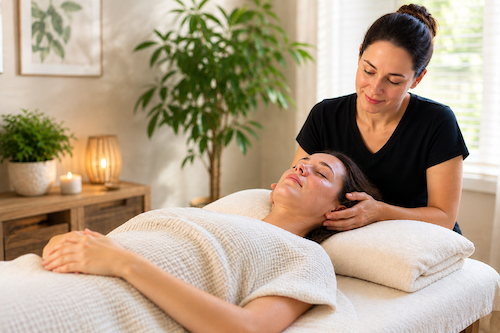 It happens more often than people expect. Someone is lying on the massage table, relaxed and quiet, and they suddenly start to cry. It can feel confusing and even a little alarming.
The most common explanation you'll hear is that massage is "releasing stored trauma from the body." That sounds riveting, but it's not supported by evidence.
Massage doesn't just affect muscles. It changes how the brain regulates emotion. Touch influences the nervous system, emotional state, and how we process internal experiences.
Research shows that supportive, nurturing touch is associated with reduced anxiety, improved well-being, and physiological shifts consistent with a calmer body and mind - lower heart rate and blood pressure, and increased parasympathetic (rest-and-recover) activity. While the exact biological mechanisms are still being studied, touch clearly influences how safe, regulated, and emotionally open we feel.
When the nervous system downshifts like this, emotions that were being "pushed aside" or "overridden" can come into awareness. Not because they were trapped in your muscles, but because they may become easier to notice and process. This can look like a deep sigh, a feeling of calm, and sometimes tears.
Crying during massage is a normal human response to relief, overwhelm, or vulnerability. But it doesn't mean the same thing for everyone. Individual history plays a role. For example, responses to touch can differ based on early life experiences and emotional background.
So what looks like a sudden emotional moment is often the result of multiple factors coming together, including a calm environment, focused attention on the body, reduced external demands, and a nervous system that has shifted into a less vigilant state.
If you've ever cried during a massage, it doesn't mean something is wrong with your body, or that you have some deeply rooted trauma that needs to be released. It means your system has the safety it needs to do exactly what it's designed to do.
Sources:
Touch neuroscience (McGlone et al., 2014)
Massage outcomes (Moyer et al., 2004)
Perimenopause Relief: Self-Massage for Mood Swings, Pain, Stress, & Sleep
Why am I suddenly feeling so hot?
Why am I crying all the time?
What's with the aches and pains?
It's no mystery - it's perimenopause.
If you're feeling it too, this simple guided self-massage is for you.
In this video, I'll show you how to relieve common perimenopause symptoms including mood swings, anxiety, muscle tension, headaches, menstrual discomfort, back pain, TMJD, and sleep issues.
We'll work through simple, effective techniques for the:
- Lower back & pelvic (cramps and achiness)
- Abdomen (digestion, bloating)
- Head, jaw & temples (headaches, jaw tension, stress)
- Neck & shoulders (stiffness, aches, and anxiety)
This gentle, full-body approach helps calm your nervous system, reduce pain, and support your body through hormonal changes.
Use this routine anytime you need relief, or before bed to support better sleep.
What's new with me ...
Sienna is thrilled the sprinklers in the playground are officially on for the summer! I can't believe she's finishing 7th grade this month. We're looking forward to a visit with family and celebrating my birthday in Charlotte, NC.

Call or text me today
917-359-8641
I'd be happy to answer
any questions you have!
Massage@Rachel-Richards.com
Subscribe to my Youtube channel!


Available now!

Available now!

Did you know?