News: March 2026
You Are Unique - So Is Your Pain
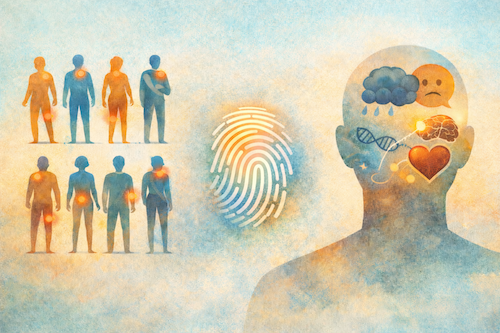 Have you ever noticed how two people can have the same injury, yet completely different pain experiences? One might be sidelined for weeks while the other keeps moving, unfazed.
Pain was once explained like a fire alarm: damage happens, a signal travels to the brain, and we get pain. That theory has long since been debunked. Pain is created by the brain after weighing sensory input alongside past experience, stress, emotion, expectation, social context, and even genetics. Rather than a simple alarm, pain functions more like a deeply personal biological and life-story fingerprint. Each person's pain is uniquely their own.
Each of us is born with slightly different nervous system wiring. Subtle differences in genetics, immune activity, and stress response influence how sensitive we are to pain and how effectively our bodies quiet it.
But biology is only the beginning. If past injuries or illnesses were paired with fear, uncertainty, or helplessness, the brain maps those experiences and becomes more protective in similar situations later on. That usually shows up as more pain.
Expectations, beliefs, and cultural norms also dictate how pain is experienced. Even a clinician's words can increase or decrease the sense of threat in the nervous system.
And have you noticed how pain intensifies when you're feeling stressed? When life feels overwhelming, the nervous system becomes more alert and protective, turning up the volume on pain.
This is one reason massage therapy can feel so powerful. When someone feels safe, cared for, and understood, both stress and pain decrease. Add to that the release of muscular tension, the soothing sensory input, and the profound relaxation that a skillful massage provides, and the result can feel downright transformative.
Pain is not random. It's a deeply personal, intelligent, protective process shaped by your body, your life, and your world. And because pain is influenced by so many factors, it can also be supported from many directions, such as education, movement, stress-reduction, connection, emotional support, and, of course, massage therapy.
Understanding Your Pain Fingerprint
So how do you begin to understand your own pain fingerprint - the unique mix of sensations, emotions, thoughts, relationships, and history that affects when your body shifts into protection?
The Pain Fingerprint Worksheet offers a gentle place to start. It's designed to help you notice patterns in your experience and bring clarity to sensations that may have once felt confusing or unpredictable. As you move through it, you may also notice your language around pain becoming more compassionate and precise.
Returning to this reflection over time can help you better understand how your pain works, support your nervous system's ability to adapt, and gradually reshape your fingerprint.
If you'd like to explore this for yourself, you can download the worksheet and begin at your own pace.
Source: Troy Lavigne, "Pain Is Individual: A Personal and Biological Fingerprint"
After-Work Self-Massage
Had a long day sitting at a computer and feeling stiff, achy, or stuck in your body? This guided post-work self-massage is designed to help you release tension, restore movement, and feel human again.
This routine is done standing, making it perfect for right after work when your body feels tight from sitting, typing, and staring at screens. We'll gently massage and stretch areas that tend to hold the most tension, including the wrists, forearms, neck, shoulders, chest, scalp, jaw, and eyes.
In this video, you'll experience:
- Gentle standing self-massage for after work
- Relief for neck, shoulders, wrists, and forearms
- Scalp and facial massage to ease headaches and eye strain
- Chest opening to counteract desk posture
- Slow, calming movements to help your nervous system unwind
Give your nervous system the input it needs to let go after a long day.
Perfect for:
- Desk workers & laptop users
- Anyone feeling stiff, tense, or overstimulated after work
- People looking for gentle, evidence-informed self-care
What's new with me ...
We had a great trip to Charlotte, NC to visit family during the February school break. Sienna always loves the indoor waterpark and the huge playground at beautiful Freedom Park. It was also a nice break from NYC's cold and snow.
March means my baby girl is turning 13. She is super excited to be a teenager! We're looking forward to several celebrations.
Call or text me today
917-359-8641
I'd be happy to answer
any questions you have!
Massage@Rachel-Richards.com
Subscribe to my Youtube channel!


Available now!
Available now!
Did you know?